Strategy
The Product Life Cycle
Written by Jeff Lombard · Last Updated:
Download PDF
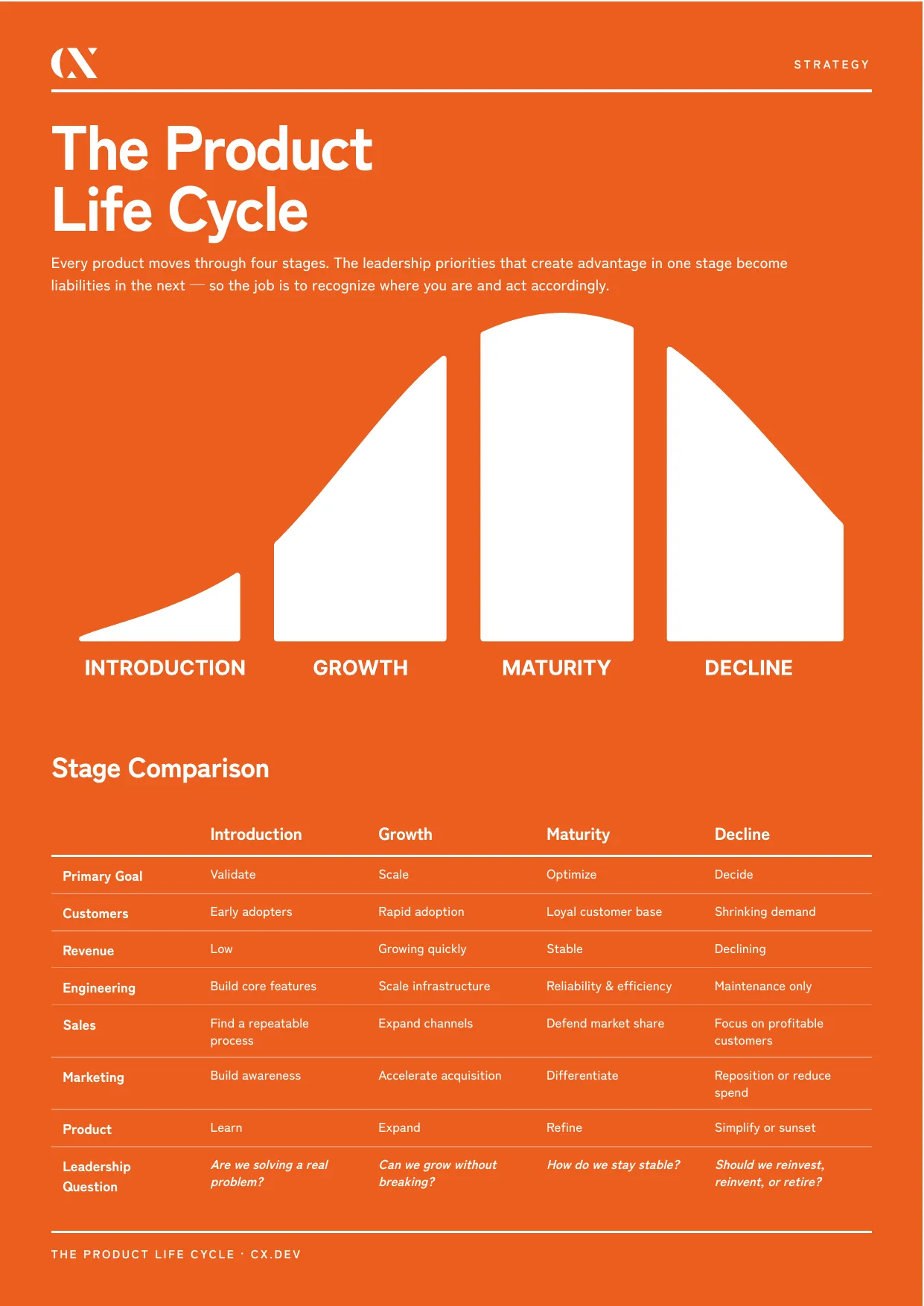
Product Life Cycle
| Stage | Description |
|---|---|
| Introduction | Your product has launched, but you’re still validating demand, refining the offering, and proving that customers will consistently buy and use it. |
| Growth | Customer demand is increasing. The focus shifts from proving the product works to scaling sales, operations, engineering, and customer success without creating bottlenecks. |
| Maturity | Growth begins to level off. The priority becomes maintaining stability, improving profitability, retaining customers, and optimizing the product rather than expanding it. |
| Decline | Demand, engagement, or competitiveness starts to fall. Leaders must decide whether to reinvest, reposition, replace, or retire the product before it becomes a liability. |
Stage Comparison
| Introduction | Growth | Maturity | Decline | |
|---|---|---|---|---|
| Primary Goal | Validate | Scale | Optimize | Decide |
| Customers | Early adopters | Rapid adoption | Loyal customer base | Shrinking demand |
| Revenue | Low | Growing quickly | Stable | Declining |
| Engineering | Build core features | Scale infrastructure | Reliability & efficiency | Maintenance only |
| Sales | Find a repeatable process | Expand channels | Defend market share | Focus on profitable customers |
| Marketing | Build awareness | Accelerate acquisition | Differentiate | Reposition or reduce spend |
| Product | Learn | Expand | Refine | Simplify or sunset |
| Leadership Question | Are we solving a real problem? | Can we grow without breaking? | How do we stay stable? | Should we reinvest, reinvent, or retire? |