The Case for Forward-Deployed Engineering
Written by Jeff Lombard · Last Updated:
Download PDF
Competitive advantage isn’t built by writing software faster. It’s built by reducing the distance between reality and the people changing it.
The organization doesn’t adapt to the software.
The software slowly adapts to the organization.
Everyone calls this digital transformation.
Almost nobody notices that the transformation happened in the opposite direction.
The organization doesn’t adapt to the software. The software slowly adapts to the organization.
The Ideology of Requirements
Reality, unfortunately, refuses to cooperate.
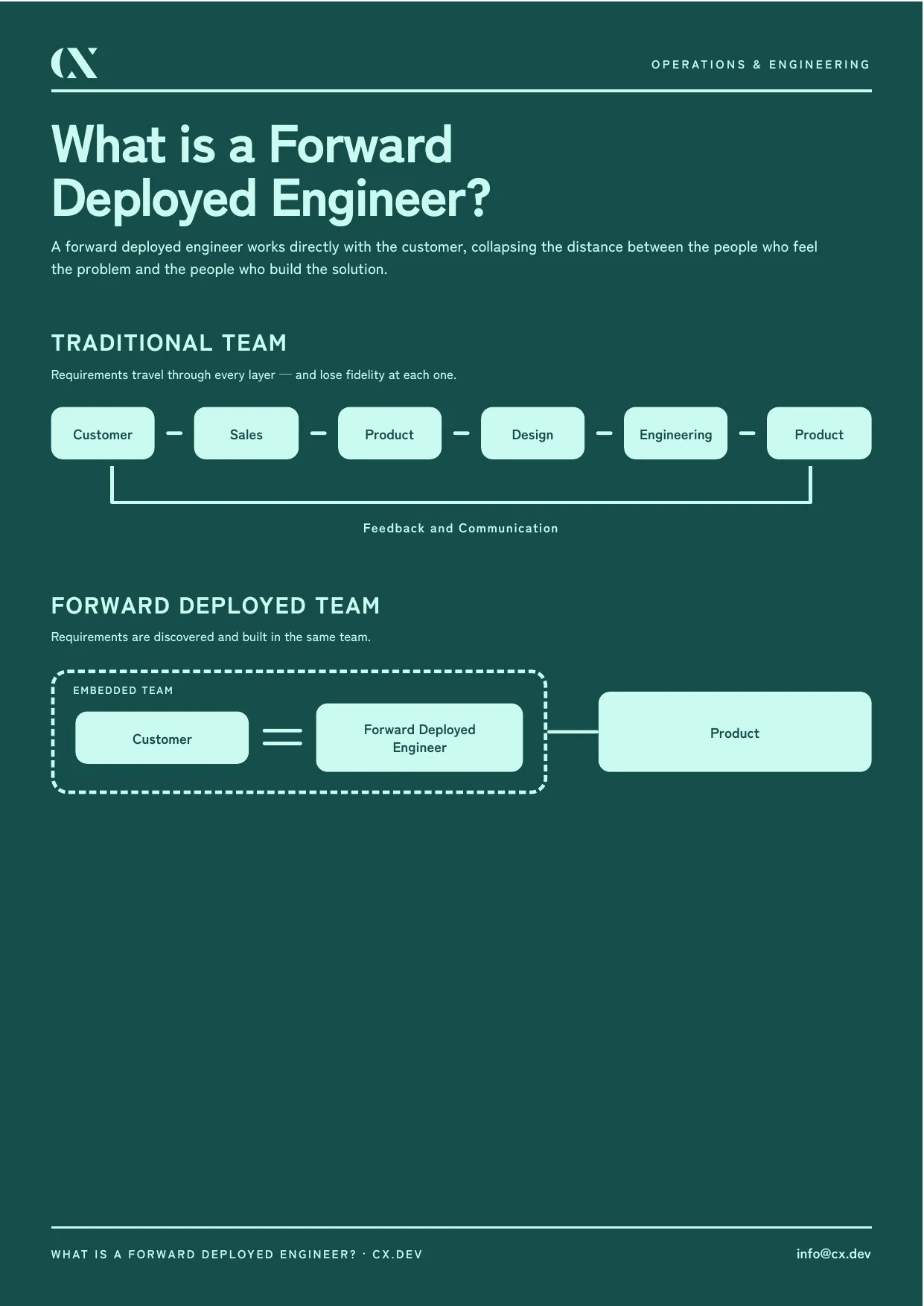
Every layer between reality and engineering becomes another place where truth can be lost.
Every layer between reality and engineering becomes another place where truth can be lost.
What Is Forward-Deployed Engineering?
The medium doesn’t matter.
The feedback loop does.
The New Constraint
Software has become dramatically easier to produce.
Understanding hasn’t.
Writing code is no longer the expensive part.
Learning what should exist is.
This changes the economics of software.
The companies that win won’t necessarily build faster.
They’ll learn faster.
Software has become dramatically easier to produce. Understanding hasn’t.
Learning Is the Competitive Advantage
Forward-deployed engineering reduces inventory.
Not by writing code faster, but by shortening the distance between observation and action.
Why Design Matters More Than Ever
Left on their own, engineering organizations tend to optimize for the people building the software rather than the people using it.
The result is predictable.
More dashboards.
More control panels.
More settings.
More reports.
The software becomes easier to manage and harder to use.
Design exists to challenge that instinct.
It asks a different question: What is this experience like for the customer?
As AI makes software cheaper to produce, the competitive advantage shifts away from building features and toward designing experiences people actually want to return to.
Design is how businesses keep technology easy to use and focused on people instead of itself.
Forward-Deployed Doesn’t Mean Office-First
Reality doesn’t care whether it’s observed from a conference room or a laptop.
What matters is whether the observation changes the system.
Insisting that everyone be in the office can actually increase the distance from reality. Modern software is built for people who work from airports, homes, factories, hospitals, coffee shops, and customer sites. If engineers are forced back into an office, they stop experiencing technology the way it was designed to be used.
The industry spent forty years making computing portable. Laptops replaced desktops. Smartphones replaced landlines. Cloud computing replaced server rooms. Requiring everyone to sit in the same building reverses that progress for the sake of management convenience, not better products.
Your customers aren’t in your office.
They’re on construction sites, hospital floors, factory lines, retail stores, and living rooms. That’s where your software succeeds or fails. If you want engineers to build better products, let them spend more time where customers actually work—not where managers can see them.
Forward deployment reduces the distance between engineers and reality—not the distance between engineers and each other.
The goal isn’t to put engineers in an office.
The goal is to put them where reality is.
Reality Is the Advantage
Documentation records what an organization believed yesterday.
Reality is what customers are doing today.
Competitive advantage is the speed at which reality changes your organization.
Forward-deployed engineering is simply one way of making that distance smaller.
Reality cannot be delegated. It must be observed.