Sales & Marketing
How Businesses Win: The Evolution of Competitive Advantage
Written by Jeff Lombard · Last Updated:
Download PDF
For most of history, businesses competed through production, quality, sales, and marketing. As each became widely accessible, it ceased to be a durable advantage.
Every era of business has had a dominant answer to the same question: why do customers choose one company over another?
The answer keeps changing.
Not because the old answers stopped mattering, but because they stopped being rare. Once every competitor can do something well, doing it well no longer wins. It merely qualifies you to compete.
That pattern has repeated four times. We’re now living through the fifth.
The Four Stages
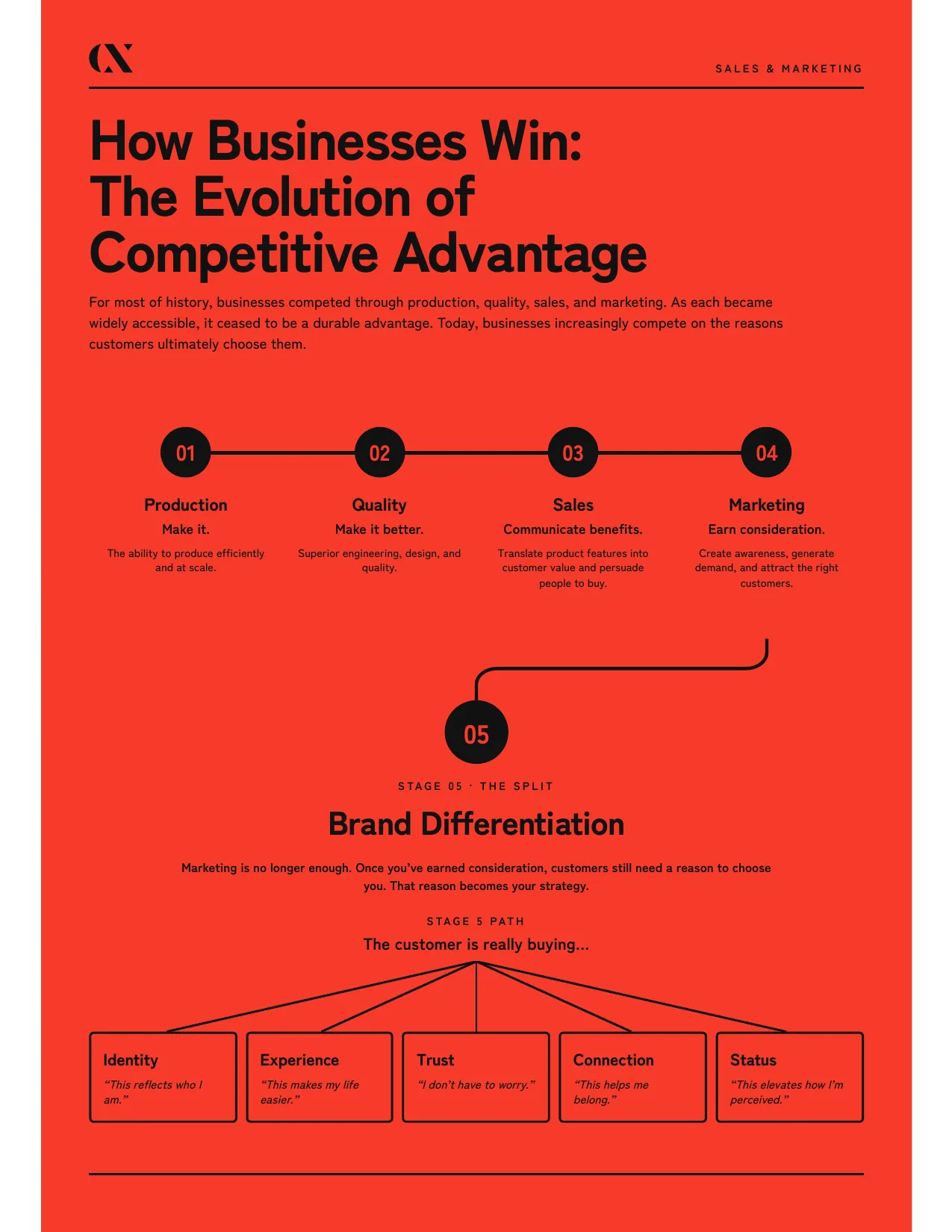
| Stage | Advantage | The Idea |
|---|---|---|
| 01 · Production | Make it. | The ability to produce efficiently and at scale. |
| 02 · Quality | Make it better. | Superior engineering, design, and quality. |
| 03 · Sales | Communicate benefits. | Translate product features into customer value and persuade people to buy. |
| 04 · Marketing | Earn consideration. | Create awareness, generate demand, and attract the right customers. |
Production
When making things was hard, the companies that could make them efficiently and at scale won.
Manufacturing capacity was the moat.
Then production techniques spread, supply chains globalized, and the ability to make things became table stakes.
Quality
When everyone could make it, the advantage shifted to making it better.
Superior engineering, design, and quality separated winners from the rest.
Then quality systems, standards, and tooling spread too. Good became the baseline. Customers stopped being impressed by products that simply work.
Sales
When products converged, the advantage moved to the companies best at explaining them — translating features into customer value and persuading people to buy.
Then sales methodology became a discipline anyone could learn, and buyers gained access to more information than any salesperson could control.
Marketing
When selling wasn’t enough, the advantage moved upstream: create awareness, generate demand, and attract the right customers before the competition ever gets a conversation.
Then marketing channels became accessible to everyone. Every company runs the same playbooks on the same platforms, bidding on the same attention.
Stage 05: The Split
Marketing is no longer enough.
Once you’ve earned consideration, customers still need a reason to choose you.
That reason becomes your strategy.
This is where the path splits. Unlike the first four stages, there’s no single next rung on the ladder. Brand differentiation isn’t one thing — it’s a choice about what the customer is really buying when they buy from you.
| Path | The customer is really buying… |
|---|---|
| Identity | “This reflects who I am.” |
| Experience | “This makes my life easier.” |
| Trust | “I don’t have to worry.” |
| Connection | “This helps me belong.” |
| Status | “This elevates how I’m perceived.” |
Identity
Some customers buy a reflection of themselves. The product says something about who they are and what they value. Brands that win here make choosing them feel like self-expression.
Experience
Some customers buy ease. The product removes friction, saves time, and makes life simpler. Brands that win here obsess over every interaction, not just the product itself.
Trust
Some customers buy peace of mind. They want to stop worrying about whether it will work, whether they’ll be taken care of, whether they made the right call. Brands that win here are relentlessly reliable.
Connection
Some customers buy belonging. The product connects them to a community, a movement, or people like them. Brands that win here build something customers join, not just something they purchase.
Status
Some customers buy elevation. The product changes how they’re perceived by others. Brands that win here are deliberately selective about who and what they’re associated with.
What This Means
The earlier stages didn’t disappear. You still have to produce efficiently, build quality products, sell effectively, and market well.
But those are now the price of admission, not the source of advantage.
The companies that win today are deliberate about stage five. They know which reason they’re competing on — identity, experience, trust, connection, or status — and they align the entire business behind it.
The companies that struggle are the ones still competing on stages one through four, wondering why being good at everything no longer feels like enough.
Customers don’t just buy what you make. They buy their reason for choosing you. Pick that reason on purpose.