Strategy
Fibonacci Scaling: A Better Way to Build Products
Written by Jeff Lombard · Last Updated:
Most product teams make one of two mistakes.
They either underinvest too early, producing something so rough that they learn almost nothing, or they overinvest too early, spending weeks polishing an idea that has not yet earned the right to exist.
Fibonacci Scaling is a simple way to avoid both.
The idea is to increase the amount of effort invested in a product, feature, or system only as confidence increases.
Instead of deciding upfront that something deserves two weeks, two months, or twenty engineers, start extremely small and scale the investment progressively:
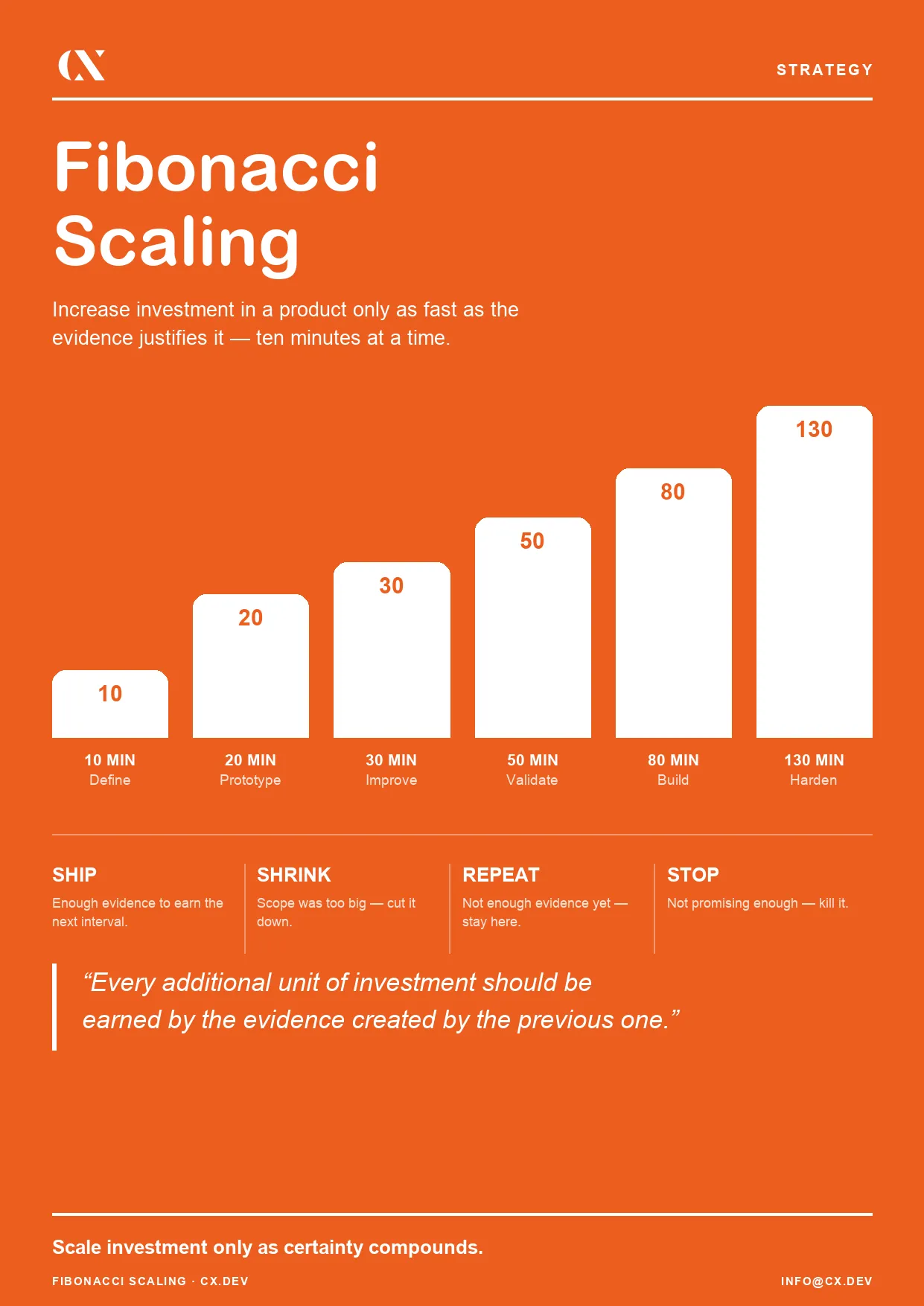
10 minutes → 20 minutes → 30 minutes → 50 minutes → 80 minutes → 130 minutes…
The exact numbers are less important than the principle:
Every additional unit of investment should be earned by the evidence created by the previous one.
Start with ten minutes
The first interval should feel almost uncomfortably small.
That is intentional.
You are not trying to finish the product in ten minutes. You are trying to determine whether the idea deserves twenty.
10 minutes: Define the smallest useful problem
In ten minutes, answer only the essentials:
- Who is this for?
- What problem are we solving?
- What is the smallest useful outcome?
- What assumption could invalidate the idea?
The deliverable should be tiny.
For example: one clear problem statement and one hypothesis.
If you cannot get there in ten minutes, that itself is useful information.
What happens when the timebox ends?
This is one of the most important parts of Fibonacci Scaling.
The timebox is not an estimate of how long the work should take. It is a forced decision point.
When the interval ends and the work is not finished, you have four options.
Ship. The deliverable is complete enough to create feedback. Advance to the next interval.
Shrink. The scope was too large. Reduce it until you can finish something meaningful within the current level of investment. Instead of “Define our entire brand,” shrink it to “Write one positioning statement and three brand principles.” This is often the best response.
Repeat. You have learned enough to justify another interval at the same level, but you have not earned a larger investment yet. Take another ten-minute block. Do not automatically advance to twenty minutes simply because the first ten minutes expired.
Stop. The idea does not appear valuable enough, clear enough, or promising enough to justify additional effort. Kill it. That is not failure—avoiding unnecessary investment is one of the primary goals of the system.
The rule is simple:
At the end of every block: Ship, Shrink, Repeat, or Stop.
Only Ship earns the next Fibonacci increment.
Why this matters
Without a hard timebox, work tends to expand.
A one-hour branding exercise becomes an afternoon. A prototype becomes a three-day engineering project. A small feature becomes an architecture redesign. Eventually the team says, “We’ve already spent this much time on it, so we might as well finish.”
That is exactly the behavior Fibonacci Scaling is designed to prevent.
The constraint forces you to change scope, rather than silently increasing investment. If something cannot be finished inside the interval, the first question should not be “How much more time do we need?” It should be “What is the smallest thing we can finish that will teach us something?”
20 minutes: Prototype
Now create the fastest possible representation of the idea. That might be a Figma screen, a spreadsheet, a prompt, a landing page, a manual workflow, a small script, or a clickable prototype.
The prototype does not need to scale. It needs to answer a question.
At the end of twenty minutes, make the same decision: Ship, Shrink, Repeat, or Stop.
30 minutes: Improve
React to what you learned. Fix the most obvious weakness. Remove unnecessary complexity. Make the workflow clearer.
Improve only what materially increases your ability to learn. Do not polish for its own sake.
50 minutes: Validate
Put the idea in front of a real user, stakeholder, or environment. Look for behavior rather than compliments.
Do they understand it? Can they use it? Does it solve the problem? Would they use it again?
The purpose of this interval is to replace assumptions with evidence.
80 minutes: Build the first real version
Only now does the idea begin receiving more meaningful investment. Build something real enough to use.
The goal is still not completeness. It is to create a stronger experiment.
130 minutes: Harden
Improve reliability. Handle the most important edge cases. Add instrumentation. Remove operational friction. Clean up the parts that real usage has shown to matter.
Keep scaling only when the evidence improves
From here, the intervals continue increasing according to the Fibonacci sequence. The project receives larger amounts of time only because previous stages have reduced uncertainty.
That is the core relationship: investment goes up as uncertainty goes down.
This leads to a useful rule:
Never scale effort faster than you scale confidence.
Fibonacci Scaling is really capital allocation
The framework is not fundamentally about productivity. It is about deciding where increasingly valuable resources should go.
Time is capital. Engineering attention is capital. Design attention is capital. Management attention is capital. Marketing spend is capital.
Each stage asks the same question: has this idea earned another unit of capital?
Traditional planning often decides the entire investment before enough information exists. Fibonacci Scaling makes investment incremental.
Small pieces, finished completely
There is another important constraint. Each increment should produce something finished—not one more piece of a giant unfinished project. A small completed artifact.
A finished landing page can be tested. A finished prototype can be shown. A finished API endpoint can be called. A finished ad can run. A finished workflow can be measured.
Finished work creates feedback. Feedback creates information. Information reduces uncertainty. Reduced uncertainty justifies additional investment.
That is the engine behind Fibonacci Scaling.
Apply it everywhere
The same framework works beyond software.
Branding. 10 minutes: define the audience and positioning. 20 minutes: write three brand principles. 30 minutes: create a rough visual direction. 50 minutes: apply it to one real page. 80 minutes: test the complete direction. Only later do you earn a comprehensive brand system.
Marketing. Do not begin with a large campaign. Start with the smallest meaningful experiment: one ad, one audience, one message, one landing page. If it works, increase the investment. If it does not, shrink, repeat, or stop.
Product development. Do not build twenty features. Build the smallest useful workflow. Test it. Then earn the next feature.
Internal systems. Do not spend a month designing the perfect operating system for a company. Solve one recurring problem. Run the system. Observe it. Then decide whether it deserves more structure.
The sequence creates discipline
The Fibonacci sequence itself is not magic. Its value is that each step is meaningfully larger than the previous one without allowing investment to explode immediately.
It prevents the jump from “this seems like a good idea” to “let’s spend three months building it.” Instead, the progression becomes: show me ten minutes of evidence, then twenty, then thirty, then—now you’ve earned fifty.
Confidence and investment grow together.
Earn the right to scale
The central rule of Fibonacci Scaling is simple: you do not receive more resources because you ran out of time.
You receive more resources because the previous investment produced enough evidence to justify them.
If the work does not fit inside the interval: shrink it, repeat it, or stop it. Do not simply let the deadline slip.
Start with ten minutes. Finish something. Learn. Then decide whether the idea deserves twenty. Then thirty. Then fifty.
The objective is not to move slowly. It is to make sure that large investments are made only after small investments have shown you where to put them.
Scale investment only as certainty compounds.