Operations & Engineering
The Agile Cost of Change Curve
Written by Jeff Lombard · Last Updated:
Download PDF
The goal of Agile isn’t to eliminate change. It’s to make change affordable.
One of the central promises of Agile is surprisingly simple.
Change shouldn’t become dramatically more expensive as a project progresses.
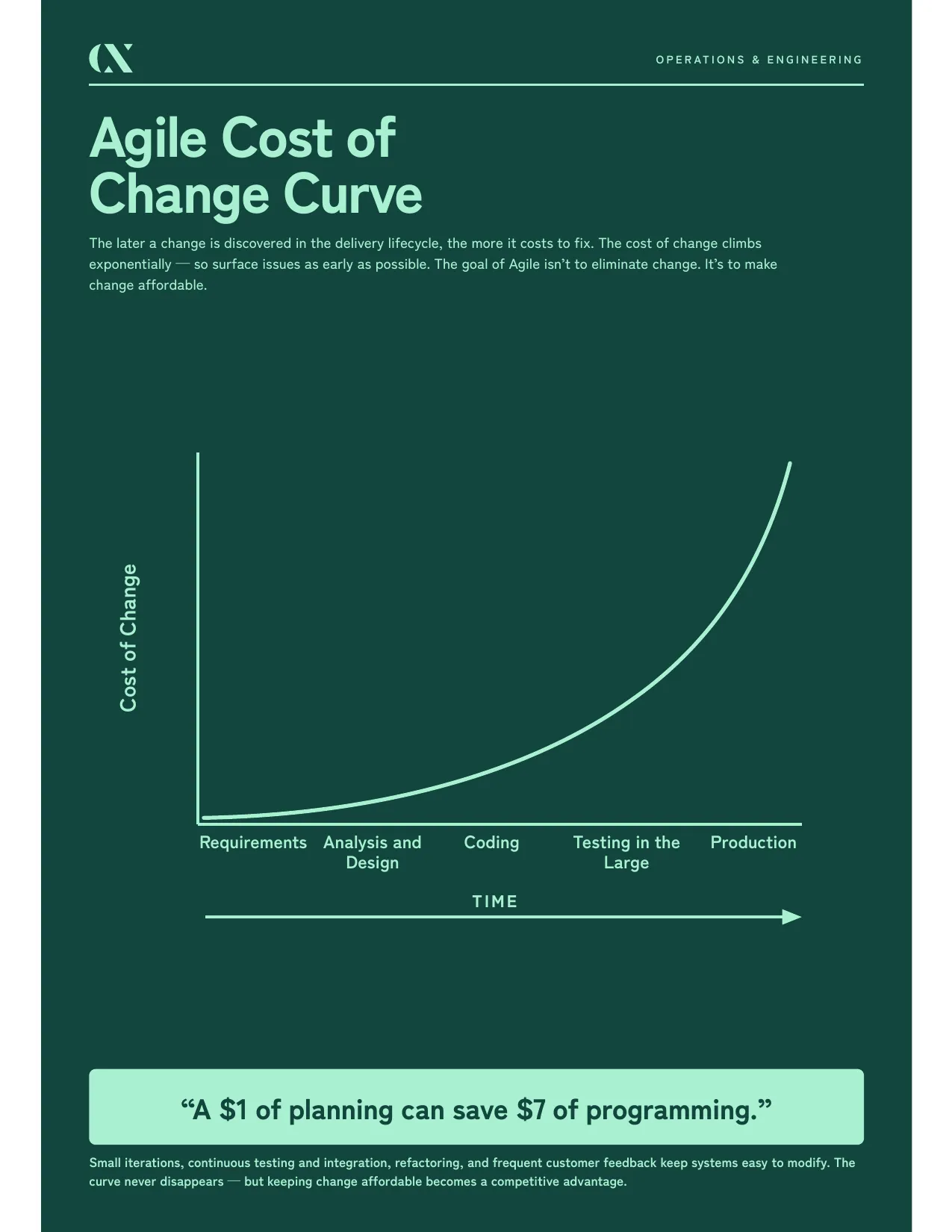
For decades, software engineering operated under a different assumption. Traditional methodologies taught that mistakes become exponentially more expensive to fix over time. If a requirement changes after release, the cost could be hundreds of times greater than changing it during planning.
That assumption produced an entire industry of documentation, sign-offs, change control boards, and lengthy planning phases designed to eliminate uncertainty before development began.
Agile challenged that assumption.
Not by pretending change disappears.
By making change cheaper.
The Traditional Cost of Change
In traditional software development, every phase locks in more decisions.
Requirements become designs.
Designs become code.
Code becomes tests.
Tests become production systems.
Each layer creates additional dependencies that must be updated whenever something changes.
A seemingly small request, such as renaming a field or changing a business rule, may require updating documentation, database schemas, APIs, automated tests, integrations, user interfaces, training materials, and customer support documentation.
As the system grows, every change touches more pieces.
The cost rises rapidly.
Organizations often respond by trying to avoid change altogether.
The traditional response to expensive change is to prevent change.
Agile’s Argument
Agile accepts that change is inevitable.
Markets change.
Customers change.
Competitors change.
Businesses learn.
If change is unavoidable, then the goal shouldn’t be eliminating change.
The goal should be reducing the cost of responding to it.
Instead of assuming software becomes rigid over time, Agile encourages teams to continually refactor, automate testing, simplify designs, and keep systems easy to modify.
Rather than producing a steep curve, Agile aims to flatten it.
Changes made late in development should still be practical rather than catastrophic.
How Agile Flattens the Curve
Several engineering practices work together to keep software flexible.
Small Iterations
Working in small increments limits the amount of unfinished work.
Problems are discovered sooner while they’re still inexpensive to address.
Continuous Testing
Automated tests provide confidence that existing functionality still works after changes are introduced.
Without automated testing, every modification carries increasing risk.
Continuous Integration
Developers merge changes frequently instead of accumulating weeks or months of work.
Smaller integrations create fewer surprises.
Refactoring
Agile treats code as something that should continuously improve.
Rather than allowing technical debt to accumulate indefinitely, engineers regularly simplify designs, improve abstractions, and remove unnecessary complexity.
Customer Feedback
Releasing software frequently allows businesses to validate assumptions before investing heavily in the wrong direction.
The cheapest feature to fix is often the one you never needed to build.
Software isn’t valuable because it’s finished. It’s valuable because it can continue adapting.
Why This Matters to Business
The cost of change isn’t just an engineering problem.
It directly affects business agility.
A company whose software can be modified in days can respond to competitors, customer requests, regulatory changes, and new opportunities much faster than one requiring months of planning.
Reducing the cost of change becomes a competitive advantage.
Businesses that adapt faster often outperform businesses that simply execute faster.
The Common Misunderstanding
Many organizations interpret Agile as “moving faster.”
That’s only part of the story.
Speed is valuable because it creates more opportunities to learn.
The real objective is preserving optionality.
Software should remain flexible enough that today’s decisions don’t permanently constrain tomorrow’s opportunities.
A team capable of safely changing direction every week is more valuable than one capable of implementing the wrong plan twice as fast.
The Reality
Agile doesn’t eliminate the cost of change.
Changing a mature production system will almost always be more expensive than changing a design document.
Dependencies still exist.
Risk still increases over time.
What Agile argues is that disciplined engineering dramatically reduces how quickly those costs increase.
The curve doesn’t disappear.
It becomes much flatter.
That difference changes everything.
When change remains affordable, businesses become more willing to experiment, learn, and improve instead of defending decisions simply because they’re expensive to reverse.
Ultimately, Agile isn’t about writing software faster.
It’s about building software that remains adaptable long after the first release.
The best software isn’t the software that never changes. It’s the software that’s easy to change.