Brand & Design
A Better System for Building Websites
Written by Jeff Lombard · Last Updated:
Most website projects begin with a blank canvas.
This feels creative, but it introduces hundreds of decisions before anyone knows which decisions matter. Teams debate layouts, revise wireframes, explore visual directions, and produce content for structures that may change. Work accumulates, feedback arrives late, and the website becomes more expensive without necessarily becoming more effective.
At CX.dev, we start differently.
We begin with a proven website template. It gives the project an initial design language, a set of reusable components, and clearly defined spaces for content. This is not about producing a generic website or limiting creativity. It is about removing unnecessary uncertainty so the team can focus on the decisions that create value.
Constraints make the work more concrete. Clients can respond to something visible instead of imagining an abstract design system. Writers know how much content a section needs. Designers can concentrate on brand expression rather than repeatedly solving standard interface problems. Developers begin with known patterns instead of rebuilding common functionality.
The template is a starting system—not the finished website.
Start with the desired response
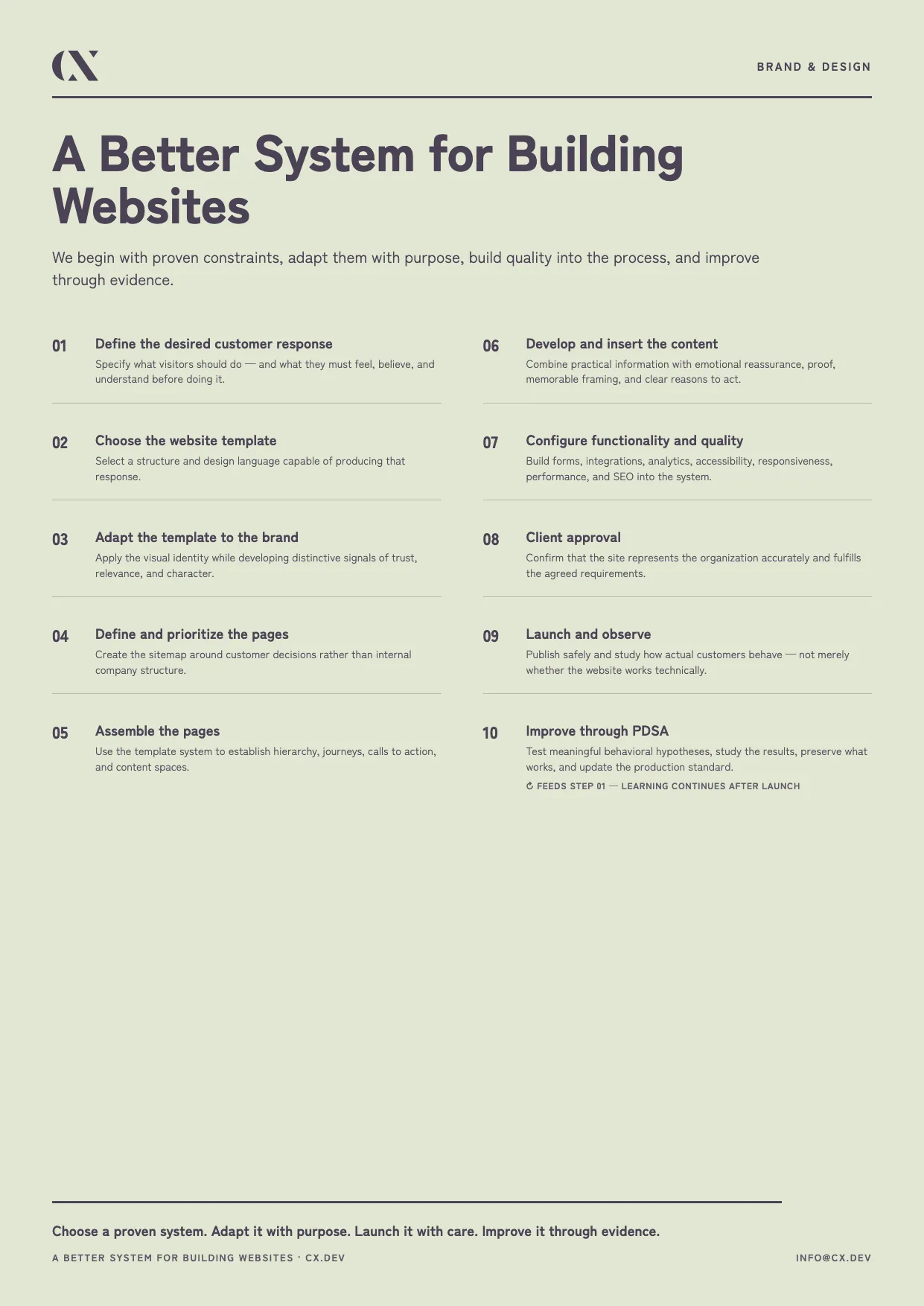
Before changing colors or assembling pages, we establish what the website needs to accomplish.
What should visitors do? What must they understand before taking that action? What uncertainty might prevent them from moving forward? What should the organization communicate through its appearance, language, and behavior?
A website does more than distribute information. It creates expectations. It signals whether an organization is credible, careful, approachable, established, specialized, or distinctive. These impressions affect behavior long before a visitor evaluates a rational list of features or services.
This gives the project an aim against which later decisions can be evaluated.
Choose and adapt the system
We select a template whose structure and design language support the desired customer response. We then adapt it to the client’s identity through typography, color, imagery, voice, spacing, and other brand elements.
Brand adaptation is not simply placing a logo in the header. The website should produce the right impression consistently. Every page, interaction, image, and piece of language contributes to that impression.
The goal is not to make every element unique. It is to make the overall experience unmistakably appropriate to the organization.
Define the pages around customer decisions
Once the system has a visual direction, we define the required pages and their relationships.
Each page receives a purpose. It should help a particular visitor answer a question, reduce uncertainty, evaluate an option, or take an action. This prevents the sitemap from becoming a reflection of the company’s internal structure rather than the customer’s needs.
We prioritize the most important journeys and determine what evidence, explanations, and actions each page must contain.
Assemble before perfecting
We assemble the pages using the template’s established components and content spaces. This creates the structure of the complete website early, while changes remain inexpensive.
With the pages visible, content becomes easier to develop. Writers are no longer producing copy in isolation. They can see the role of every headline, paragraph, image, proof point, and call to action within the customer’s journey.
Content must do more than describe the organization accurately. It must help people make decisions. That often requires reassurance, specificity, evidence, memorable framing, and a clear reason to act.
We add custom components only when the customer or content genuinely requires them. Novelty is not automatically valuable. A familiar interaction that works reliably is often better than a distinctive one that creates confusion.
Build quality into the website
Functionality and quality are not separate finishing phases.
Forms, integrations, content management, responsive behavior, accessibility, performance, analytics, privacy, and security are developed as parts of the same system. Each page should work when it is created—not become “complete” only after a final inspection.
Standards make this repeatable. They reduce reliance on memory, individual heroics, and last-minute corrections. When a problem recurs, we improve the process that allowed it rather than treating every instance as an isolated mistake.
Approve the complete experience
The client reviews the assembled website to confirm that it represents the organization accurately, contains the required information, and supports the agreed customer journeys.
Approval is an important commitment point, but it is not proof that the website will succeed. Internal stakeholders can confirm accuracy and organizational fit. Only real customers can reveal how the website performs under real conditions.
That distinction matters. Approval prepares the website for release; observation prepares it for improvement.
Launch with care
A launch is more than publishing files.
We complete the technical SEO and fit-and-finish work required for the website to operate as a coherent whole. This includes metadata, structured data, redirects, internal links, performance, accessibility, responsive behavior, form delivery, analytics, consent, privacy, security, domain configuration, and production verification.
We then publish the website and observe it.
Do visitors follow the expected journeys? Where do they hesitate? Which messages produce interest? Are important pages being discovered? Do forms and integrations behave correctly in production? Are the signals we selected helping us understand performance?
The objective is not to react impulsively to every fluctuation. It is to distinguish meaningful patterns from ordinary variation and use evidence to guide the next decision.
Launch is the beginning of knowledge
Every website is built from a theory: that certain information, presented in a particular way, will help particular people take a desired action.
Launching allows that theory to meet reality.
We compare behavior with our expectations, study the differences, and improve the website through deliberate cycles. Effective changes become part of the standard system. Ineffective ideas are revised or abandoned. What we learn strengthens both the website and the process used to maintain it.
The result is not simply a collection of attractive pages. It is a reliable system for creating customer confidence, supporting useful action, and learning over time.
That is how CX.dev builds websites: begin with proven constraints, adapt them with purpose, build quality into the process, and improve through evidence.